If you have ever searched for Indian recipes around Chhath Puja time, you have probably noticed how one particular sweet dominates every conversation. Thekua was the fourth most searched Indian recipe in 2025, and for good reason. It is not just food. For millions of families in Bihar, Uttar Pradesh, Jharkhand, and the Terai belt of Nepal, thekua is prasad. It is devotion shaped into a crisp, fragrant disc of wheat flour, jaggery, and ghee.
This guide covers everything you need to make thekua at home, whether you are preparing for Chhath Puja or simply want to try this ancient sweet for the first time.
What Is Thekua and Why Does It Matter
Thekua (also spelled thikuwa or khajuria in some regions) is a hard, deep-fried sweet made from whole wheat flour, jaggery, and ghee. It is offered to Surya Dev (the Sun God) during Chhath Puja, one of the most rigorous festivals in the Hindu calendar. Devotees fast without water for over 36 hours, and the prasad they offer, including thekua, carries immense spiritual significance.
The name "thekua" likely derives from the wooden mould (thekai) traditionally used to press patterns into the dough. These moulds, carved with flowers, peacocks, and geometric designs, have been passed down through families for generations. Today, some families still use old wooden moulds, while others use metal cookie stamps or simply shape the dough by hand with a fork.
What makes thekua different from other Indian sweets is its shelf life. Made correctly, thekua stays good for 10 to 15 days at room temperature. This made it practical in a time before refrigeration, and it still makes it ideal as prasad to distribute to large gatherings.
Ingredients for Thekua (Makes approximately 25 to 30 pieces)
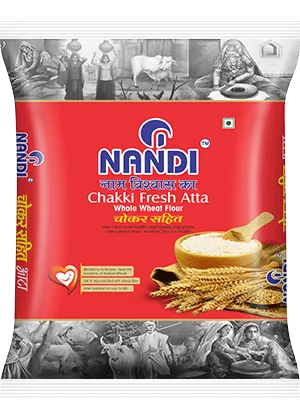
- 2 cups whole wheat atta (preferably fine-ground, like Nandi Choker Sahit Atta)
- 3/4 cup jaggery (gur), grated or roughly broken
- 3 tablespoons ghee, plus more for deep frying
- 1/2 cup warm water (adjust as needed)
- 1/2 teaspoon cardamom powder
- 2 tablespoons fresh grated coconut or desiccated coconut (optional but traditional)
- 1 tablespoon fennel seeds (saunf)
- A small pinch of salt
Step-by-Step Method
Step 1: Prepare the Jaggery Water
Dissolve the grated jaggery in warm water. Stir until fully dissolved, then strain through a fine mesh to remove any impurities. Let it cool to room temperature. This is important: if the jaggery water is too hot when you add it to the flour, the ghee will melt unevenly and your thekua will not hold together properly.
Step 2: Mix the Dough
In a wide bowl, combine the atta, cardamom powder, fennel seeds, coconut (if using), and salt. Add the ghee and rub it into the flour with your fingertips until the mixture resembles coarse breadcrumbs. This step, called "moyan" in Hindi, is what gives thekua its characteristic crumbly-yet-crisp texture.
Now gradually add the jaggery water, a little at a time, and bring the dough together. Do not knead it like chapati dough. Thekua dough should be stiff and firm, not soft. If it feels sticky, add a tablespoon of dry atta. If it crumbles and does not come together, add a teaspoon of water at a time.
Step 3: Shape the Thekua
Pinch off a small ball of dough, roughly the size of a large marble. Press it firmly into your thekua mould, then tap it out. If you do not have a mould, roll it slightly flat and press the tines of a fork across the surface to create a pattern. The dough should hold its shape without cracking. If it cracks, the dough is too dry. If it sticks to the mould, dust the mould lightly with dry atta.
Step 4: Fry the Thekua
Heat ghee in a kadhai on medium-low flame. The temperature matters a great deal here. Drop a small piece of dough into the ghee; it should rise slowly to the surface with gentle bubbling. Too hot and the outside will brown before the inside cooks. Too cool and the thekua will absorb excess fat and turn soggy.
Fry in small batches, 5 to 6 pieces at a time, for 8 to 10 minutes, turning occasionally. The thekua will deepen to a warm golden-brown. Do not rush this step. Properly fried thekua should feel completely firm when you press it with the back of a spoon. Transfer to a plate lined with kitchen paper.
Tips for Perfect Thekua Every Time
- Use good-quality jaggery. Fresh, dark jaggery gives a deeper flavour than pale, processed varieties. Avoid the pre-powdered kind, which sometimes has additives.
- The flour matters. Thekua made with fine whole wheat atta has a better texture than one made with very coarse flour. Nandi Choker Sahit Atta is ideal here because it retains the bran for nutrition but is ground fine enough for even frying.
- Do not skip the moyan (fat rubbing). This step creates tiny pockets of fat in the dough that expand during frying, giving thekua its distinctive short, biscuit-like crunch.
- Keep the flame consistent. Medium-low is the right setting on most gas stoves. Electric induction users may need to adjust between settings 4 and 5.
- Cool completely before storing. Hot thekua releases steam, which causes softness. Spread them on a tray and let them cool for at least 2 hours before putting them in an airtight container.
Variations Worth Trying
Coconut Thekua
Double the coconut quantity to 4 tablespoons. Some families in Mithila add a tablespoon of khoya (mawa) as well. The result is richer and slightly chewier in the centre, with a golden crust that carries a distinct coconut aroma.
Dry Fruit Thekua
Finely chop cashews, almonds, and raisins and fold them into the dough. These are typically made for distributing as prasad at home rather than for formal Chhath Puja offerings, where plain thekua is preferred. Still, as a festive snack, dry fruit thekua is something else entirely.
Baked Thekua
A lighter version that many families now make for everyday eating rather than as prasad. Brush the shaped thekua with a small amount of ghee and bake at 180 degrees Celsius for 20 to 25 minutes, turning once halfway through. The texture is slightly different, less rich, but still satisfying.
Storing Thekua
Thekua stores remarkably well. Once completely cool, place them in an airtight tin or glass container. At room temperature in a cool, dry kitchen, they stay fresh for 12 to 15 days. In summer, or in humid regions, move them to the refrigerator after day 5 or 6. Reheat briefly in a dry pan or in the oven to restore the crunch if needed.
Avoid storing thekua with other moisture-releasing foods or in plastic bags without a proper seal. The crunch is the whole point, and any moisture will ruin it.
The Cultural Heart of Chhath Puja
Chhath Puja is one of the few major Hindu festivals with no temple involvement. It is entirely performed outdoors, at riverbanks or ponds, with the rising and setting sun as the focal point. The vrat (fast) is among the strictest in the Indian calendar. Devotees fast without water for 36 hours, bathe in rivers before sunrise, and offer prasad including thekua, seasonal fruits, and sugarcane directly to the sun.
The prasad preparation itself is sacred. Kitchens are cleaned thoroughly, and traditionally only the vrati (the fasting devotee) or close family members with clean hands prepare the prasad. Many families insist on using brass or clay utensils. And the atta? It is always whole wheat, freshly milled if possible, because purity of ingredients is as important as purity of intention.
This is why the flour choice matters beyond just taste. Atta made with a high-quality wheat blend and minimal additives is not a premium preference during Chhath, it is a requirement.
Make your Chhath Puja prasad with Nandi Choker Sahit Atta. Stone-ground from whole wheat, with the bran retained for nutrition and the grind kept fine for smooth doughs. No additives, no bleaching. Just atta the way it used to be made. Order on Blinkit and get it delivered in minutes.